Welcome to the blog dedicated to advancing all forms of rail in the city of Evansville. Whether it's high speed rail, light rail, freight rail, commuter rail, cable cars, maglev rail, or even personal rapid transit, rail is Evansville's future. Please send all questions and comments to JordanBaer1@gmail.com.

Sunday, November 27, 2011

Why Did Dennis Avery Select Chicago Over Indianapolis?

(destination360.com)

Back in 2009, we were fortunate to have a glimmer of hope for passenger rail coming to Evansville when State Representative Dennis Avery tried to get $300,000 from Indianapolis to study an Evansville to Chicago route...

http://www.indianaeconomicdigest.net/main.aspSectionID=31&subsectionID=298&articleID=47391

"I believe there are some people that would much prefer to put their car in the garage and take the train," Avery said.

This was the first time, in a long time, that we came close to actually pursuing passenger rail in Evansville. Although Avery said the study wouldn't have been for high speed rail, it would indeed have connected into the high speed rail grid...

"The network Obama unveiled amplifies Chicago's role as a key hub and includes high-speed routes that would connect Chicago to Indianapolis, and then Indianapolis to both Louisville, Ky., and Cincinnati. But Evansville wouldn't be connected to those routes.

Avery said the fact that major Indiana cities such as Evansville and Terre Haute are close to the network "basically points out the importance of having a study to see if western Indiana would be a desirable route.""

Unfortunately, when budget talks heated up in Indianapolis, the study was scrapped. I found this to be nothing short of hypocritical for Indianapolis to claim there is no money to study a passenger rail route for Evansville when they are planning on spending well over $5 billion on Interstate 69.

Nonetheless, some of those who opposed or were skeptical of the study wanted Avery to pursue an Evansville to Indianapolis route instead of one going to Chicago...

http://www.courierpress.com/news/2010/oct/03/high-speed-rail-the-issue-amtrak-looks-to-our-we/

"Here in Indiana, much of the talk and hope has been about linking Chicago, Indianapolis, Louisville and Cincinnati as part of a Midwest high-speed rail network. While Evansville isn't on that map, State Rep. Dennis Avery attempted last year to secure $300,000 for a study of passenger rail service between Evansville and Chicago. We felt at the time that an Evansville-to-Indianapolis route might find more support in Southern Indiana, but alas, it didn't matter. Avery's request was erased from the proposed state budget amid worries about more immediate state needs."

Of course, as we all know the Evansville Courier & Press published the above article as one of their latest attempts to stop anything that they feel would threaten their boondoggle known as I-69 from being completed. So much for "more immediate state needs." However, there are some who support rail but question why Chicago should receive priority over Indianapolis even though Indianapolis is our state capital.

One organization, The Transport Politic, even proposed a route from St. Louis to Louisville going through Evansville but did not include any routes from Evansville to Chicago or Indianapolis...

http://www.thetransportpolitic.com/2009/02/01/a-future-interstate-rail-network-redux/


But there is a reason for this selection. If you look at the overall goal for high speed rail...
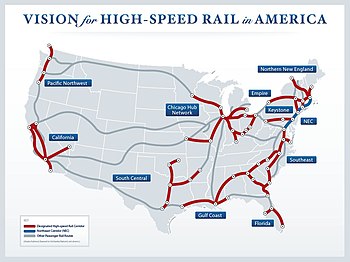


You will see that both St. Louis and Louisville are important hubs connecting to the ultimate hub for the Midwest High Speed Rail Network- Chicago.

And if you look at the Midwest High Speed Rail Network specifically...

(indygov.org)

You will notice that all rail lines in the Midwest will head to Chicago. Why is this? Because there is a new economic model emerging in the United States. This model is called megaregions. What are megaregions?

http://en.wikipedia.org/wiki/Megaregions_of_the_United_States

"A Megaregion, also known as a Megalopolis or Megapolitan Area, refers to a clustered network of American cities whose population ranges or is projected to range from about 7 to 63 million by the year 2025.

A megaregion is a large network of metropolitan regions that share several or all of the following:

Environmental systems and topography
Infrastructure systems
Economic linkages
Settlement and land use patterns
Culture and history

The Regional Plan Association recognizes 11 emerging megaregions:

Arizona Sun Corridor Megaregion
Cascadia Megaregion
Florida Megaregion
Front Range Megaregion
Great Lakes Megaregion
Gulf Coast Megaregion
Northeast Megaregion
Northern California Megaregion
Piedmont Atlantic Megaregion
Southern California Megaregion
Texas Triangle Megaregion

More than 70 percent of the nation's population and jobs are located in 11 megaregions identified by Regional Plan Association."

Here is a map of the 11 megaregions...

http://www.rpa.org/america2050/sync/elements/america2050map.png

Why is it important to have a direct route to Chicago, the capital of our megaregion?

1. The vast majority of flights over 600 miles leaving the megaregion will go through Chicago.

2. The vast majority of goods that are being shipped to the Midwest will go through Chicago.

3. The vast majority of the population in the Midwest will either live in Chicago or on a high speed rail line that goes directly to Chicago.

4. Having a direct line to Chicago will allow us to reach the rest of the Midwest Network as they will have direct lines running into Chicago as well.

5. Having a direct line to Chicago will allow us to tap into their human intellectual knowledge as well due to the fact that the entire Chicago population will be within a few hours of reaching Evansville.

There are also a few other minor reasons why a route to Chicago should take priority over Indianapolis...

1. Evansville to Chicago is served by a CSX-Class I Railroad which makes it an easier line to upgrade for high speed rail.

2. Evansville to Chicago also has a CSX side spur at Terre Haute that goes to Indianapolis making an Evansville-Terre Haute-Indianapolis route cheaper and more productive that an Evansville-Bloomington-Indianapolis route.

3. Chicago already has a bigger population than Indianapolis.

So while reaching Indianapolis, the capital of our state, may seem to be the best solution, reaching Chicago, the capital of our megaregion makes much more sense.

If Evansville is truly going to join the rest of the Midwest in establishing both national and international connections, we must send politicians to Indianapolis who share the same vision that Dennis Avery had for Evansville.

We must go to Chicago before we go to Indianapolis!

Wednesday, November 9, 2011

Let's Make Lloyd Winnecke Evansville's First High Speed Rail Mayor

(courierpress.com)

Now that the election is over, it is now more than clear that Evansville is divided by more than US 41. Yesterday's election was gut wrenching if you supported Rick Davis for mayor (as I did) or it was legendary if you supported Lloyd Winnecke for mayor.

First and foremost, thank you Treasurer Rick Davis for running for mayor. Of all of the campaigns I have worked on, which includes several in Lexington, KY, a few in Seattle, WA, and a few here in Evansville, this has been the most fulfilling one for me. I will never forget it and I am thoroughly saddened that it's over. At Rick's town hall meetings, several rail supporters came to him with questions about Evansville's future in passenger rail. Rick gave his full support for high speed rail and he said he would fight for it. Thank you Rick for listening to the High Speed Rail Movement!

Next, I would like to congratulate Commissioner Winnecke on becoming our 34th mayor. Commissioner Winnecke has worked hard for Evansville, and I appreciate him willing to take on the task of being mayor for Evansville.

So with all of that being said, Evansville is at a crossroads (no pun intended) when it comes to transportation. We can continue going down that same path known as the interstates that aren't safe, they aren't productive for job creation, they aren't clean, they aren't fast, they aren't cheap or affordable, and they have taken their toll on the environment.

Or, we can choose to go down a new path. That path is high speed rail. High speed rail offers Evansville a chance of a lifetime. With high speed rail, we have the opportunity to create jobs by the thousands with a slack water port next to our rail lines (both passenger and freight), the opportunity to transport residents safely as high speed rail has only had one fatal accident in its 47 year history, the opportunity to clean up our environmental emissions, the opportunity to save farmland, the opportunity to prevent urban sprawl, the opportunity to work in Bloomington while living in Evansville, and the opportunity to finally join the rest of the U.S in the 21st century.

During this past election, Commissioner Winnecke indicated support for both I-69 and high speed rail. Although we are a divided city right now, we absolutely, positively need to make Commissioner & Mayor-Elect Winnecke aware of the benefits of choosing rails over roads.

In his plan "Moving Evansville Forward," Commissioner Winnecke said the following about high speed rail...

http://media.courierpress.com/media/static/Moving_Evansville_Forward.pdf

"Passenger rail in Indiana is currently limited to the northern and middle sections of the state. INDOT released the Indiana Rail Plan in 2009. The report acknowledged the potential economic benefit an increased passenger rail system would have on Indiana. This is why it is imperative that Evansville be included in any future plans for an extended passenger rail network. Current plans for improved rail coverage in Indiana woefully omit Evansville as a stop on any potential passenger rail system. As mayor, I will insist that Evansville be placed on any map as a stop on a new Midwest rail system.

There has also been a push at the federal level to encourage the development of high speed rail in the middle region of the country. The Federal Rail Administration has identified High Speed Rail Corridors throughout the country. One of these corridors connects Chicago, IL to Louisville, KY. The latest plan also neglects Evansville as a primary or secondary hub for this system. Once again, I will fight for the people of Evansville to be certain that our city is properly connected to a Midwest High Speed Rail system and takes full advantage of any economic benefit. "


This is a very well-written and thought out statement from Mr. Winnecke. I thank him for his willingness to embrace high speed rail in a town that doesn't like change. I, and I hope you will join me, must make sure Mr. Winnecke sticks to his campaign promise once he becomes mayor.

For those who aren't familiar with the Midwest High Speed Rail Movement, please check out these links in this post...

http://evansvillerail.blogspot.com/2011/06/take-look-at-our-high-speed-rail-region.html

Those who oppose high speed rail have tried all kinds of scare tactics. They have tried the following...

1. Claiming high speed rail is only being pursued in the Northeast Corridor and California. They are wrong, high speed rail is coming to the Midwest, and we must build into the system.

2. Said high speed rail is unaffordable. Yet, on average, high speed rail costs 1/4th the price of interstates.

3. Said high speed rail is a money loser. They are wrong big time on this claim. High speed rail is profitable while interstates don't even come close...

http://evansvillerail.blogspot.com/2011/06/it-makes-financial-sense-to-build-high.html

I have no doubt that high speed rail opponents will continue to use these scare tactics as well and many others. For this reason, if we are ever going to get high speed rail in Evansville, our leader and our mayor Lloyd Winnecke must be in full support of high speed rail. This is what happens when you don't prepare for high speed rail...

http://www.wndu.com/hometop/headlines/83076777.html

I trust Lloyd Winnecke will make the right decision on high speed rail. He has the ability to influence our economic development coalition, our chamber of commerce, the Evansville Courier & Press, our state and federal leaders, and many more who have the power to pursue high speed rail.

Congratulations Commissioner Lloyd Winnecke and I hope you will give high speed rail a chance!

(http://www.flickr.com/photos/stephenmosleymp/5866326058/)

Wednesday, October 26, 2011

You Want Safety? Ride The Rails!

(usdotblog.typepad.com)

Since the Chinese witnessed their high speed rail system rack up over 40 fatalities last August in an accident that has since been blamed on design flaws in the rail signal equipment, many critics of high speed rail have used this incident for their rationale that high speed rail isn't safe.

As you will see in the article below, this couldn't be any farther from the truth. High speed rail's safety record, which has seen zero fatalities in France, Spain, and Japan and only one in Germany, is light years ahead of the automobile.

We've been told that building I-69 is necessary for the safety of those commuting from Evansville to Bloomington. This couldn't be any farther from the truth as well. Although automobile fatalities are decreasing sharply, they aren't anywhere near the safety level of high speed rail.

Every year, over 30,000 Americans die in automobile related accidents. There were 814 fatalities in 2008 in Indiana, and In 2009, 680 people died on Indiana roads. This does not include those who were injured but survived, and it does not include damages done by the automobile to personal property.

The following article, which can be found on the website for California's proposed high speed rail system, illustrates perfectly why we need to invest in high speed rail.

**********************************************************************************
http://www.cahighspeedrail.ca.gov/safety.aspx

Why are high-speed trains the safest form of transportation?

High-speed train systems have been operated safely every day in other parts of the world for many years. The unparalleled safety record for high-speed trains is based upon their actual operating experience. For example, in Japan high-speed train operations began in 1964. In over 44 years of operation, Japanese high-speed trains (the “Shinkansen”) have carried more than 9 billion passengers without a single train related fatality. In France, their high-speed trains (the “TGV”) have been operating for 27 years and currently carry more than 100 million passengers a year. Like Japan, the French high-speed train system has never had a single high-speed train related passenger fatality on the completely dedicated new line such as will be built in California.

In contrast, the automobile is unquestionably the most used and most dangerous when comparing auto, air and rail modes of transportation. In 2004 alone, there were over 4,000 fatalities and more than 200,000 nonfatal injuries on California highways. The National Highway Traffic Safety Administration estimates that deaths and injuries resulting from motor vehicle crashes are the leading cause of death for persons between the ages of 4 and 33 in the United States. With more and more vehicles on our highways, the potential for automobile accidents increases.

What makes high-speed trains so safe?

High-speed trains have the proven record as the safest and most reliable form of transportation in the world as a result of separating high-speed trains from other forms of traffic and implementing automated positive train control that safeguards against human error.

High-speed trains operate on grade separated tracks designed for high-speeds. Most train accidents are the consequence of passenger and freight trains using the same tracks and with a signaling and switching system that depends on humans. 87% of California’s 800-mile route will be on new completely separate track reserved for the exclusive use of high-speed trains.

The key distinguishing reasons for the near perfect safety record of high-speed train travel in Europe and Asia are summarized below. (The California High-Speed Rail Project will incorporate all of these safety features, building upon the proven safety and design criteria used for existing high-speed train systems in Europe and Asia):

The entire high-speed train system is fully access controlled and grade-separated (there are no at grade crossings with roads, pedestrians, or other rail services), eliminating pedestrian and motor vehicle conflicts.

The high-speed train systems are completely double-tracked with additional tracks at intermediate stations to support express operations.

The trains are centrally monitored and controlled, effectively preventing operators from making serious errors, stopping or slowing trains automatically in the event of external problem such as earthquakes, objects falling on the tracks, or gale force winds. High-speed train traffic control and communications systems are state-of-the-art, regulated, and managed during all hours of operation. These systems monitor and limit the train’s speed, schedule, routing, and headway (following distance behind another train). These systems, combined with the operator, have integral redundancy and ensure safety.

Heavy, conventional freight trains do not share infrastructure designed for high-speed operations.

High-speed trains use a cab signaling system that transmits commands directly to the driver. This technology makes high-speed operation possible in darkness, rain, and fog. In Japan, even moderate snowfall does not slow the Shinkansen because of special ice-melting equipment built into the rail bed.

Unlike aircraft, high-speed train systems are not subject to turbulence. Passengers may sit without seat restraints and may stand and walk comfortably even at maximum speeds and around curves.

Although high-speed train systems do operate in highly seismic areas, such as Japan, no fatalities have ever occurred as a result of a seismic event. The control system is linked to motion detectors close to faults having the potential to affect the line, even hundreds of miles from the line The systems stops the trains when an earthquake is detected, and at-grade construction in fault zones further improves safety.

Like airplanes, and other public intercity modes, high-speed trains and the infrastructure they operate on (tracks, control systems, and electrification systems) are be maintained on a regular schedule and the maintenance records would be subject to inspection by the Federal Railroad Administration. This regular inspection of both rolling stock and track would ensure the safety of the high-speed train system.

In California, key safeguards will prevent unwarranted access to the system. The California high-speed train system would be a fully grade-separated and fully access-controlled guideway with intrusion monitoring systems in place. This means that the train system’s infrastructure (e.g., mainline tracks and maintenance and storage facilities) would be designed to prevent access by unauthorized vehicles, persons, animals, and objects and to detect breaches of the system. The capital cost estimates include allowances for appropriate barriers (fences and walls), state-of-the-art communication, access-control, and monitoring and detection systems. All aspects of the California high-speed train system would conform to the latest federal requirements regarding transportation security. High-Speed trains will not require lengthy “airport style” screenings because like other passenger rail transportation services operating throughout the United States, high-speed trains do not present as great a security risk as air transportation.

************************************************************************************

It's pretty obvious that high speed rail, not I-69, is the answer to safety for those traveling to and from Bloomington. Furthermore, I-69 does not provide a safe route for those going from Evansville to Terre Haute or for those going from Terre Haute to Bloomington.

Wouldn't it be nice to pick up the paper and read "Zero Fatalities in Indiana" everyday? Wouldn't it be nice to ride safely on high speed rail knowing you will reach your destination? And wouldn't it be nice knowing that high speed rail will not cause damage or harm to any of neighborhoods it travels through?

It you want to be safe, you better ride the rails!

(distinctivenurseries.com)

Sunday, October 2, 2011

I-69 Supporters Just Can't Answer The Big Questions

(deanhunt.com)

What does Governor Mitch Daniels, the Evansville Courier & Press, and those who support I-69 have in common? Answer: None of them can answer the big questions regarding the construction of this boondoggle and unneeded interstate. Let's take a look at some of the recent articles that prove this...

http://www.courierpress.com/news/2011/sep/27/bloomington-mpo-should-open-county-to-i-69/


According to the Herald Times newspaper of Bloomington, the Bloomington/Monroe County Metropolitan Planning Organization submitted 109 questions to INDOT last week, as it said it would on Sept. 9 when it delayed a vote on whether to include construction of I-69 in Monroe County in its county transportation plan.

According to the Bloomington newspaper, among the questions was the most familiar — how does the state plan to complete financing of the highway between Bloomington and Indianapolis?


That's a very simple question, correct? After all, didn't the C&P themselves write an editorial against high speed rail citing costs as the main reason for not pursuing it?...

http://www.courierpress.com/news/2010/oct/03/high-speed-rail-the-issue-amtrak-looks-to-our-we/

It's quite ironic, and hypocritical to suggest that high speed rail is unaffordable when construction costs average 1/4th the price of interstates...

http://www.indianahighspeedrail.org/whyHSR.htm

So how would the C&P answer this simple question?...


At this point, INDOT probably cannot answer that question with anything near certainty. As everyone knows, Gov. Mitch Daniels pulled financing for the Evansville to Crane stretch out of his hat with the Major Moves highway initiative.


THERE YOU HAVE IT. The C&P has finally admitted they don't have a clue how to finish this road off. We've been told that Roberts Stadium can only stand if it there's a business plan for it to make money. We've been told that high speed rail is too expensive and shall be financed only through the private sector. Yet the C&P endorses a road that doesn't even stand a chance of getting finances for completion, much less profitability which as we all know roads don't profit.

Could you imagine if we built half of an arena without enough financing to complete it? Could you imagine only building a fraction of New North High School? I-69 supporters love complaining about US 41 not being a true interstate, yet we are now going to have an interstate connecting to a freeway. What's the difference? This is exactly why the Lloyd Expressway and the Greenway are in the shape they're in.


Beyond that, unless Daniels comes up with another innovative idea, it may well be up to the next governor and legislature to finish financing, either through traditional sources of highway funding or perhaps with some form of user fee, such as tolls, or both.


Governor Daniels has already tried tolling the interstate, I-69 supporters wanted no part of that. The highway fund is depleted (as it should be), and there isn't even enough money left to repair existing infrastructure much less add to this boondoggle. Basically, it's thanks for nothing! I-69 opponents have warned the state about this since the very beginning. Now, we all see that they were right.


Regardless, there is no sensible reason to stop construction cold in its tracks at Crane, as opponents of I-69 would seem to prefer. It would be best to construct the highway as far as possible, so as to be ready when issues involving the Bloomington to Indianapolis link are resolved.


We have crumbling bridges, an economy that has been hampered due to the fact that they can not get from Point A to Point B at speeds that high speed rail can take it, and we still have other infrastructure woes. Why should we continue with this boondoggle? There's already a route to Indianapolis and it already has powerful corporations such as Toyota and GBT on it. Let's stick with fixing US 41.


No doubt, the MPO has some legitimate questions for INDOT — questions that could have been posed a year ago — and it might benefit their community and the project to have this discussion.

You think? These questions have been posed since the very beginning. I-69 supporters cannot answer them now, and they will never be able to answer them in the future. Again, why continue?


But in the end, this project must go forward. Indeed, we hope that once the questions are answered, and discussed, the MPO will stop its petty, provincial stall tactics and open their community and the state to this much-needed highway.

Much needed highway? The C&P cannot answer basic questions such as funding, much less the lack of jobs, the environmental disaster this road is causing, and the basic truths that high speed rail is cleaner, greener, faster, cheaper, produces more jobs, safer, and more reliable. That's what we need to invest in.

For the record, I practice what I preach. Yesterday, I went to Bloomington to attend an IU football game against Penn St. Did I take state road 57 or the brief part of I-69? NO! I took US 41, state road 67, state road 54, and state road 45. After all, it is the main route listed on mapquest. I left a half hour later than when I was suppose to to get to the game, but in the end, I arrived in Bloomington a half hour before kick off. I have the following questions for the C&P and the rest of the I-69 supporters...

1. Why is new terrain being chosen over US 41/I-70 when US 41 has a main CSX route parallel to it and the new Terre Haute Bypass is under construction?

2. If you're worried about safety,why not upgrade US 41 to I-70 and convert state road 67 and US 231 to a freeway? As is, how are those students traveling to Bloomington from Vincenness, Terre Haute, or Sullivan going to get there safely?

3. Northern Indiana, Central Indiana, and Southeastern Indiana are planning for high speed rail. If we are planning a highway that isn't even funded how are we suppose to stay competitive with these regions?

4. If I-69 is all that, why is Toyota (which is the reason North American Lighting came to town) and GBT located on US 41?

5. If there isn't any funding to complete I-69, why would anyone believe there is enough to construct an Ohio River bridge?

If this editorial wasn't bad enough, we where treated to a "Community Comment" today. I-69 opponents are commonly called clowns, jokers, and nutcases. This writer just proves that it is the supporters of I-69 that are the rubes. For this reason, I'm glad they publish these articles. Let's dive into some of the comments...

http://www.courierpress.com/news/2011/oct/02/the-case-to-build-i-69-may-be-found-at-the-roads/


Now let's talk about the little towns along the way. How about Fort Branch? Will they get two exits or just one? Doesn't really matter, all of those businesses and homes along that stretch will have to come down. The few that are left will be inaccessible with only one exit.

They will die out. Same holds true for Sullivan and Farmersburg and all the other small cities, towns, businesses and homes along the way.


This is the dumbest rebuttal I have ever heard. The cost to upgrade US 41 was roughly 1/3rd of the new terrain cost. Worst of all, the current I-69 plan will destroy 400 homes, 2,800 acres of farmland, and 1,000 acres of forest. And this writer is concerned about Fort Branch? WOW!

For this reason, I-69 is the 7th worst interstate construction in the country...

http://www.infrastructurist.com/2009/03/16/highways-to-nowhere-the-7-most-ridiulous-new-roads/


Then I'd like for the people of Bloomington, on the next rainy night, to head south via Highways 37/50 and drive to Evansville. Hey, it will only take about 3 to 3 ½ hours, if you make it. Be careful, as the highway is hilly and don't forget the very sharp curves and changes in speed limits frequently mostly 50 to 35 mph. You don't get 55 mph until you get to the last stretch of U.S. 50 approaching Bedford. Then back to the hills and hollers and the slower speed limits.

Bottom line: The new highway is needed and my research shows that to redo U.S. 41 would be the most devastating to people and places.


"My research." There's the problem. My research, which included driving US 41 to Bloomington shows that state road 67, which branches off of US 41 is already being widened. My research also showed that a brand new rail line is being laid down next to the road. This rail line will compliment the new coal plant at Edwardsport. Lastly, my research tells me that would be a much better solution than the current wasteful plan.


Hey, it might cost a little more money but let's just skip Monroe County. Somewhere around Hobbieville, turn I-69 north. Skirt Monroe County, go up through Greene and Owen counties and pick up Indiana 67 and Indianapolis here we come.

So long, nut cases in Bloomington! Oh, be sure and give them an exit at Indiana 48 so they can see what they missed.

The final sentence just proves how pointless this article is to begin with. The funny thing about it, is that the writer is now advocating for state road 67 to be used anyways which would avoid Bloomington. This writer doesn't even know what he's arguing for.

Of course it might cost a little bit of money but who cares? It's not like we need to repair the Sherman Minton Bridge. And it's not like anyone would take US 41 to Terre Haute where they would get on a bypass. And it's not like this project is already under construction with Mitch Daniels HIMSELF grandstanding in front of it...

http://www.in.gov/indot/div/projects/sr641/

That photo of Mitch Daniels standing in front of the Terre Haute Bypass is further proof that he, as well as the rest of the I-69 supporters, are hypocrites.

As each week goes along, I-69 supporters show us what they are really about. They don't care about your safety going to Terre Haute, they don't care about your safety traveling over bridges that are listed in bad condition, they don't care about students going from Vincenness to Bloomington, and they don't care about Southern Indiana's future which is high speed rail.

If we are ever going to move into the 21st century, we must ignore those who support I-69 and start planning for a system that works. High speed rail is clean, green, cheaper, faster, reliable, safer, and more productive.

WHEN WILL THE C&P AND I-69 SUPPORTERS ANSWER THE BIG QUESTIONS?

(icanhascheezburger.com)

Wednesday, September 14, 2011

Another Day, Another Company Chooses US 41 & Rails Over I-69

(reuters.com)

Yesterday, Evansville got some excellent news in the form of a major announcement...

http://www.courierpress.com/news/2011/sep/13/windmill-turbine-company-bringing-40-jobs-former-w/?partner=popular

GBT, Global Blade Technology, will be moving into the old plant once occupied by Whirlpool. This is great news for our city as we will now be moving into the forefront of green technology with GBT's windmill production. It's also great news for our big blue building along US 41 which has been an icon for Evansville since WWII when it was used by Republic Aviation to construct military airplanes. There really isn't a bad piece of news from yesterday's announcement.

It's no wonder GBT selected the old Whirlpool site to set up shop. The building has a vast array of attributes that simply cannot be found along the small fragments of what is suppose to be the future I-69. The building is one of the few buildings large enough to handle windmill production and it's just minutes from downtown.

One of the main perks that GBT will enjoy at the new plant is a strong access to rail transportation, something they just would not have had if they would have located along I-69. In fact, they even have a side spur that will go right up to their back door. If you take a look at the map of railroad tracks in Southern Indiana, you will see that both the proposed I-69 corridor as well as the existing US 41 have railroad tracks somewhat close to them...

(kcdc.com)

Here is another link that shows the CSX route along I-70...

http://www.in.gov/indot/files/MAIN-RR-11_V1.pdf

But there are many differences in the two routes...

1. US 41 AND I-70 are served by CSX which is a Class I mainline railroad, while I-69 is served by ISRR (Indiana Southern RailRoad) and INRD (Indiana RailRoad Co.) are Class III and Class II secondary lines respectively. This is like trying to ship goods on county backroads versus shipping on interstates.

2. US 41 and I-70 are served by a direct route by CSX, while I-69 requires freight to be transferred from ISRR to INRD and then back to ISRR.

3. The CSX line running parallel to US 41 takes freight all the way to Chicago which is THE main hub line for all rail activity in the U.S. It is believed that the Chicago rail hub is so important that if one train hits the breaks on its route in Chicago it will form a cause-and-effect on railroads all the way to Baltimore. This line has been known as the Evansville line even though bigger cities such as Nashville and Chicago are on it...

https://blogger.googleusercontent.com/img/b/R29vZ2xl/AVvXsEiojss2Bf6rczjSOVUgfomsQkgNVbUuAdAEmIwSNxUNH28TCOItCdZMXqDzAmIgt3KHjG5KLHC-Z80UygaCjaQjFJ7Rshyphenhypheno5wp1uoo5g_9exPRScRsZTRkPhMN0KkY_VO3PT-Bx36vc7Z8Y/s320/Evansville+and+Terre+Haute+route+map.jpg

Don't get me wrong, we can and should build high speed rail and improved freight rail to Bloomington, BUT it should go up US 41 and then over at Vincenness. The following website sums up perfectly all of the economic benefits we would enjoy by going through Vincenness and Knox County (take a look at that beautiful industrial park going between US 41 and CSX)...

http://www.kcdc.com/

Ironically enough, we were given this quote from the above Courier & Press article above...

"The announcement was a testament to the diligence, hard work and preparation the city applied to make the deal possible, Weinzapfel said during a news conference at the facility, which was attended by Gov. Mitch Daniels."

This couldn't be any farther from the truth. Both the governor and mayor have fought for I-69 instead of upgrading US 41. The billions upon billions that will be wasted on I-69 should have been used to upgrade our freight and passenger rail tracks and the US 41/I-70 route to both Chicago and Indianapolis as well as Nashville.

We have been told time and time again by I-69 supporters that this interstate is necessary for job creation, yet it is US 41, not I-69, that is producing. GBT now joins Toyota along US 41, who was the company responsible for bringing in North American Lighting that I-69 supporters are trying to take credit for.

While Mitch Daniels took a short drive down I-70 and US 41 to Evansville this past week, I hope he saw all of the great things happening along the corridor. I hope he saw the economic impact that has taken place as a result of a strong CSX rail line paired with a strong and historic US 41. That is what will create jobs, not wasting $5 billion plus on an interstate through nowhere.

Let's build on GBT's commitment, let's invest in rails along US 41!

(greenfrog.com)

Sunday, August 14, 2011

Rails, Not Roads, Are The Future

(howstuffworks.com)

Last year, I decided to take a nice road trip to Omaha, Nebraska and Council Bluffs, Iowa. For those who have not been to Omaha and Council Bluffs, you should consider taking a trip there as the region is currently experiencing a high amount of growth due to their railroad heritage. Everywhere you go, a Union Pacific decal is right around the corner.

If you ever go to Council Bluffs, Iowa, make sure you check out the Union Pacific Railroad Museum...

http://www.uprrmuseum.org/

When I was in Council Bluffs, the UPRR museum was the first place I visited. It is quite an experience as you will see both railroads from the 1800s as well as railroads of the future. As I walked up to the third floor of the museum, I noticed a huge painting on the side of the wall. On the side of the wall was a painting depicting a railroad heading into the future with the caption,

" The Road To The Future Isn't A Road At All!"

This quote sums up the high speed rail movement perfectly. No longer is it acceptable for the automobile to have a monopoly on the transportation industry. No longer is it a popular belief that paving interstates will carry the U.S into the 21st century. Rails, whether they be freight, high speed, commuter, light, heavy, maglev, or personal rapid transit are the future.

Let's take a look at some of the reasons and trends that indicate a future movement to rail.

Younger Americans Are Driving Less

Contrary to what auto supporters want you to believe, younger americans, which are the future, are driving less miles.

http://www.cahsrblog.com/2010/06/the-great-shift-away-from-driving/

If you look at the graph on the link above, you will see that the percentage of miles driven by those between the ages of 21 and 30 has decreased by 7.7%. This is an enormous decline in miles traveled. The main reason for this decline is the digital revolution. When you are driving a car, you cannot surf the internet, send and receive texts, or make phone calls safely. When you're on a high speed rail, a commuter rail, or even a light rail, you can tap into the WiFi on the train and not have to worry about the road ahead. As the link says, younger people want I-Phones not cars.

Here is another link that talks about this great shift away from the automobile...

http://www.cahsrblog.com/2010/10/more-evidence-for-a-shift-away-from-driving/

Oil Prices Are On The Rise

Unless you live in a cave, you are fully aware of the rise in gas prices. The scary thing is that most people feel like the current prices are off the charts and indeed they are...

http://www.mongabay.com/images/commodities/charts/crude_oil.html

But, if you think these prices are the sky, you haven't seen anything yet. Former Shell executive John Hofmeister predicts gas prices will go over $5 a gallon in 2012...

http://thehill.com/blogs/e2-wire/677-e2-wire/135343-former-shell-executive-raises-the-specter-of-5-per-gallon-gas-prices?utm_source=twitterfeed&utm_medium=twitter

If that isn't bad enough, Deutsche Bank is predicting oil barrels to be $175 each by 2016...

http://thinkprogress.org/romm/2009/10/07/204770/deutsche-bank-oil-to-hit-175-a-barrel-by-2016-which-will-drive-a-final-stake-into-long-term-oil-demand-spurred-by-a-disruptive-technology-the-hybrid-and-electric-car-that-will-very/

So how can we avoid these high gas prices? Simply put, build rails. Unlike the automobile, rails do not shackle themselves to the oil industry therfore fares remain constant and affordable for a longer period of time.

More Americans Are Moving Into The City

Traditionally, urban sprawl has been left uncontrolled by cities of all shapes and sizes. Because of this, the automobile has been needed for someone to get from point A to point B. But now things are changing...

http://www.wgrz.com/news/article/117186/37/New-Trend-Toward-City-Living

Due to rising costs of infrastructure for urban sprawl such as sewers, roads, and power lines, many cities are rethinking urban sprawl, and many Americans are finding life in the city to be much more affordable. You can learn more about the Smart Growth Movement here...

http://www.smartgrowth.org/

Because of this great shift to the urban core of cities, more cities are investing in light rail and it is proving to be successful...

http://www.lightrailnow.org/features/f_000003.htm

Economic development is one of the main differences between rails and roads. While roads are built and designed to attract and encourage urban sprawl, rails are built and designed to encourage Smart Growth planning. Because rails offer a solution for those trying to escape urban sprawl, it is the future.

Less Opposition From Airlines

As you may know, rails compete with both the automobile and the airplane for market share. High Speed Rail has already gained significant market share overseas...

http://www.connectthemidwest.com/2010/09/high-speed-rail-grabs-market-share-of-airliners/

Now, the ACELA Express in our Northeast Corridor is gaining market share on air and auto...

http://reasonrail.blogspot.com/2010/12/acela-continues-to-gain-marketshare.html

Due to this competition, many airlines have previously hired lobbyists to defeat high speed rail movements. Previously they have been successful in states such as Texas and Florida. But as population begins to increase, many airlines are rethinking this theory.

Currently, most airports are filled with airplanes that are traveling less than 400 miles. This is proving to be quite expensive for the airline industry as these short trips are not as profitable as their long distance trips, and these airplanes are filling valuable space at airports. Therefore, the airline industry has reversed their though process on high speed rail which traditionally serves routes that are less than 400 miles. One of these airlines is JetBlue...

http://www.cahsrblog.com/2010/07/jetblue-sees-benefits-of-hsr/

Removing the barrier of airline lobbyists is a tremendous asset to the high speed rail movement as air and auto will no longer be able to double team the rail movement. Just about everyone that isn't a lobbyist for an interstate is now on the side of high speed rail.

The Vast Majority of Americans Now Support High Speed Rail Over Air And Auto

Over the past few years, the high speed rail movement has gained tremendous progress in winning the hearts of Americans. Study after study, survey after survey, and poll after poll has proven this...

http://www.cahsrblog.com/2011/03/79-of-travelers-would-use-high-speed-rail/

http://www.hntb.com/news-room/news-release/america%E2%80%99s-high-speed-rail-aspirations-remain-strong

http://www.planetizen.com/node/43117

http://fastlane.dot.gov/2011/06/us-mayors-declares-support-for-president-obamas-high-speed-rail-initiative.html

No matter what part of the U.S you live in, support for high speed rail is at an all-time high, and it has already surpassed support for the auto and air industries. This trend will only continue to grow.

There you have it, no matter what angle you look at the rails vs roads debate, one thing is clear, rails are America's future. This begs the question: Why haven't we invested in high speed rail in Evansville and why are we supporting I-69 which is expected to cost over $5 billion?

Unfortunately, interstate supporters are setting us back behind other regions again. They refuse to look into the future. Instead, only the present is what they see. Sooner or later, Evansville will wake up. At that point, Evansville will see why investing in high speed rail is vital to the success of their city. They will then see the wisdom in Union Pacific's quote. They will then understand...

"The Road To The Future Isn't A Road At All!"

(www.baileylauerman.com)

Monday, August 8, 2011

From Evansville To Minneapolis, A Bullet Train Is Better Than A Plane

(ultimatetaxi.com)

On June 9th, 2011, our local Evansville Regional Airport offered direct flights from Evansville to Minneapolis...

http://www.courierpress.com/news/2011/mar/10/evansville-airport-adding-service-minneapolisst-pa/


“For years we’ve been trying to get this service,” said Dianna Kissel,
Evansville Regional Airport’s marketing and public relations manager.

Minneapolis/St. Paul is an attractive market, Kissel said, because it
improves Evansville’s access to the Western U.S.

On June 9th our local officials decided to "celebrate" this accomplishment...

http://community-observer.com/2011/06/09/evansville-regional-airport-to-host-minneapolisst-paul-kick-off-event-on-thursday-june-9-2011/

The Evansville Regional Airport will host an open-house event from 11:30 to 1:00 on June 9, 2011 to celebrate the start of Delta’s regional jet service to Minneapolis St. Paul (MSP) starting that same day. This new service will offer local passengers many more options for west coast connections. The event includes a ribbon cutting with Mayor Weinzapfel and the Chamber of Commerce of Southwest Indiana’s Ambassadors that will start at 12:30.
That's right, it's the same officials who thought we needed a ribbon cutting ceremony for a simple Lloyd Expressway overpass at Fulton....

http://www.courierpress.com/news/2010/sep/08/ribbon-cutting-thursday-lloyd-expwy-interchange-fu/?partner=RSS

and Oak Hill Road...

http://tristatehomepage.com/fulltext?nxd_id=287197

With all of these grand ribbon cutting ceremonies, the perception appears to be that we are making progress. But I ask the simple question: Are we really investing in the best technology?

In other words, is this the best way to spend our money to get to Minneapolis? Let's take a look into the options.

According to Mapquest, if you drive from Evansville to Minneapolis, it will take you 11 hours and 56 minutes to drive 697.71 miles...

http://mapq.st/o6q0ff

The estimated cost would be around 2-3 tanks of gasoline depending on what vehicle you drive. This equates to a rough estimate of $120-$240.

According to http://www.evvairport.com/, if you take a direct route from Evansville Regional Airport to Minneapolis/St.Paul Airport, you can get there in 1 hour and 52 minutes....

http://www.quicktrip.com/flightresultpage.html

But it will cost you $1,277.00 to fly on August 9th if you go with Hotwire...

http://www.hotwire.com/air/results.jsp?searchTokenId=1&backButtonInputId=index

Or you can fly on August 24th with Hotwire for $785.75 but it will take you 3 hours 50 minutes....

http://www.hotwire.com/air/results.jsp?searchTokenId=2&backButtonInputId=air-results

(Note: These estimates were taken from Hotwire.com for the dates August 9th and August 24th. These prices and times will fluctuate up and down daily. This is only intended to be a rough estimate.)

So while there are indeed a few flights on a few days at a few times to Minneapolis that can take you there in roughly 2 hours, they are significantly more expensive than most of EVV's direct flight's to Minneapolis and really don't make financial sense over a 1 or 2 stop route or a slower route that will take roughly 4 hours.

Also, none of these times take into account the facts that you have to travel outside of downtown Evansville and vicinity to reach the airport, the 1 + hour it takes you to go through security, and the frequent delays that are a common practice in the airline industry. Simply put, when everything is calculated, we can either take a flight that will take at least 3 hours of our time and will cost almost $1,300 or we can take a flight that will take at least 5 hours of our time and will cost almost $800.

Now let's take a look at high speed rail....

http://www.midwesthsr.org/2011-economic-study

Unfortunately, Evansville is only listed as a Bus Feeder Route due to our political leaders failing to push for high speed rail in Evansville...

http://www.midwesthsr.org/sites/default/files/pdf/MHSRA_2011_Economic_Study_Executive_Summary.pdf

Therefore, we will have to use a city that is comparable to Chicago in distance. That city is St. Louis which is 6 miles farther than Evansville is to Chicago. The reason why we must get a comparable distance to Chicago is because a route from Evansville to Minneapolis would involve taking 2 trains: 1 train from Evansville to Chicago and 1 train from Chicago to Minneapolis.

If you look at page 5 of the economic study above, you will see that...

1. It takes 1 hr, 55 minutes to go from St. Louis to Chicago.
2. It takes 2 hrs, 45 minutes to go from Chicago to Minneapolis.
3. This comes to a grand total of 4 hours, 40 minutes.

If you look on page 22 of the study, you will see that a 220 mph high speed rail bullet train beats both the automobile and the airplane to many different cities around the Midwest.

Now let's take a look at the fares. Go to page 24 and lets calculate our fares by taking annual revenue and dividing it by annual riders. This calculation gives us...

1. $42.61 to go from St. Louis to Chicago.
2. $53.02 to go from Chicago to Minneapolis.
3. This comes to a grand total of $95.63 to go from St. Louis to Minneapolis which is a comparable distance with Evansville to Minneapolis.

Here are some more cost comparisons between air, auto, and rail...

http://www.midwesthsr.org/cost-advantage

While the gap in fares between air and rail gets significantly closer when we calculate bigger cities such as St. Louis, the truth is, only the rich will be able to use air service out of Evansville or anywhere else for that matter in the future.

With lengthy lines for security, oil prices on the rise, and many people moving to their town's urban core, why is Evansville investing in its airport instead of building high speed rail?

Yes, if you catch that one magical flight that goes directly to Minneapolis, you might (keyword might) be able to save an hour or less travel time, but is it worth paying $800-$1300? I don't think so. For the vast majority of flights leaving Evansville and heading to Minneapolis, their fares are significantly higher than a train ticket on a 220 mph bullet train and their travel times are longer than the bullet trains by over an hour or two.

Before we invest one more dollar in our interstates and our airport, we need to focus solely on BRINGING HIGH SPEED RAIL TO EVANSVILLE!


(elpc.com)